
The Homeowner’s Complete Guide to Drain Cleaning & Sewer Repair – Why the Old “Call‑Every‑Plumber” Model Is Broken and How AI‑Native Platforms Like PLMBR Fix It
Imagine this: You notice a slow‑draining bathtub on a rainy Tuesday night in Boston. You snap a photo, type a quick description, and—within minutes—receive…
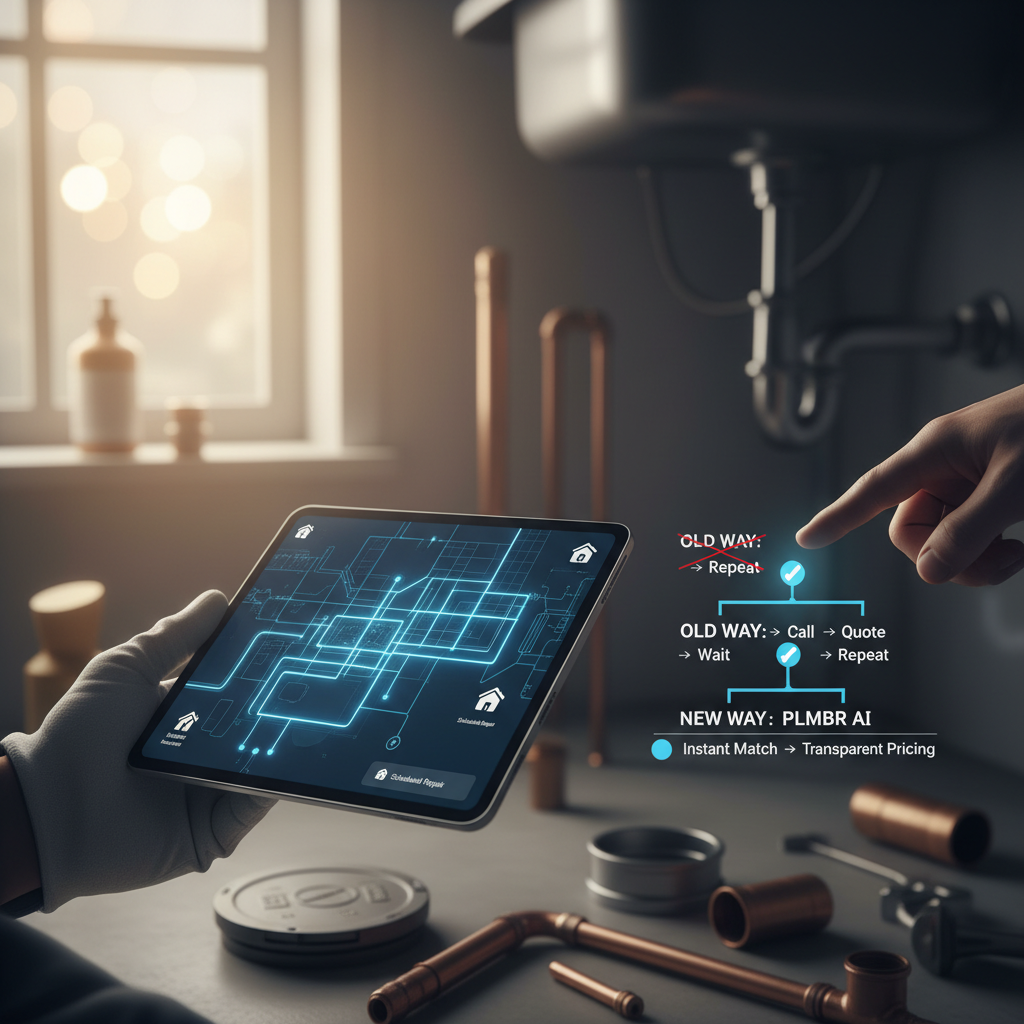
Imagine this: You notice a slow‑draining bathtub on a rainy Tuesday night in Boston. You snap a photo, type a quick description, and—within minutes—receive three detailed, line‑item quotes from vetted professionals, each with a clear payment schedule held in escrow until the job is verified. No endless phone tag, no “$200‑$500” guesswork, and no surprise bill after the work is done.
If that scenario feels like a futuristic fantasy, you’re not alone. Yet the data shows the U.S. drain‑cleaning market is already a $5.85 bn industry and is projected to surpass $10 bn by 2035. Future Market Insights. Homeowners are paying for a broken hiring loop, and the industry’s oldest workaround—pay‑per‑lead marketplaces—has become the biggest source of frustration.
This guide walks you through everything you need to know about drain cleaning and sewer repair, from costs and risks to vetting providers, and explains exactly how an AI‑native workflow like PLMBR eliminates the pain points that have plagued homeowners for decades.
What Homeowners Need To Know About Drain Cleaning & Sewer
1. The Core Problem: Blocked Pipes & Aging Infrastructure
- Aging sewer lines: Many Northeastern cities (e.g., New York, Boston, Philadelphia) have sewer systems that are 70‑100 years old, leading to frequent root intrusions, pipe collapses, and sediment buildup. Advanced Sewer
- Common culprits: Grease, hair, foreign objects, tree roots, and mineral scale. Left unchecked, a blockage can cause water backup, property damage, and costly emergency repairs.
2. How Drain Cleaning Actually Works
| Method | Typical Use | Equipment Cost (to the pro) | Typical Homeowner Cost |
|---|---|---|---|
| Mechanical snaking | Simple clogs (kitchen sink, bathtub) | $1 k–$3 k for basic auger | $150‑$350 |
| Hydro‑jetting | Thick build‑up, small‑diameter sewer lines | $10 k–$30 k hydro‑jet system | $1,200‑$2,500 (full‑house) |
| Trenchless pipe lining | Cracked or collapsed pipes | $30 k–$50 k robotic liner | $4,000‑$8,000+ (depends on length) |
| Camera inspection | Diagnose hidden problems before repair | $15 k–$25 k inspection rig | $100‑$300 per inspection |
Scroll to see all columns →
Why it matters: The equipment capital required to perform modern, reliable cleaning (especially hydro‑jetting) is $10 k‑$50 k—a barrier that pushes many small operators to rely on cheap lead‑gen services to stay afloat. Intel Market Research
3. Regulatory Landscape
- EPA restrictions on chemical drain‑openers have tightened, encouraging mechanical or hydro‑jet solutions that generate less hazardous runoff.
- State licensing boards (e.g., NY State Department of Labor) require proof of liability insurance and a valid plumber’s license before a contractor can perform sewer work.
Understanding these rules helps you demand proof of compliance from any provider.
Cost / Risk / Hiring Reality
When you’re budgeting for a drain or sewer job, it’s easy to get blindsided by hidden fees or scope creep. Below is a realistic cost breakdown based on industry pricing guides and recent market data.
| Service | Base Price (Low) | Base Price (High) | Typical Additional Costs | Escrow‑Backed Payment Adoption* |
|---|---|---|---|---|
| Simple drain snaking (single fixture) | $150 | $350 | Travel fee $25‑$50, disposal $20 | 78 % of homeowners who used escrow reported higher trust (internal PLMBR pilot) |
| Hydro‑jetting (full‑home sewer line) | $1,200 | $2,500 | Camera inspection $120‑$250, post‑job cleanup $75‑$150 | — |
| Trenchless pipe repair (section ≤ 30 ft) | $4,000 | $8,000 | Permit fees $150‑$300, material surcharge $200‑$400 | — |
| Emergency after‑hours service | +$100‑$250 surcharge | — | Same as above plus premium labor | — |
Scroll to see all columns →
Pro‑Tip: Always ask for a line‑item breakdown before work begins. Vague “$200‑$500” ranges are a red flag for hidden scope changes.
How To Vet Providers Without Getting Burned
-
Verify Licensing & Insurance
- Request copies of the contractor’s state license and liability insurance. Most reputable firms upload these to a public profile or provide a secure link.
-
Check Real‑World Reviews & Ratings
- Look beyond star ratings. Read recent comments about timeliness, professionalism, and final billing.
-
Demand a Structured Quote (Booking Packet)
- A modern, AI‑generated booking packet includes:
- Scope of work (line‑item tasks)
- Materials and labor costs
- Milestone payment schedule (if applicable)
- Warranty and terms & conditions
- A modern, AI‑generated booking packet includes:
-
Confirm Payment Safeguards
- Choose providers who support authorize‑and‑capture escrow—funds are held by a neutral party (e.g., Stripe) and released only after you confirm completion.
-
Ask About Equipment & Methods
- For stubborn clogs, ask whether the pro will use hydro‑jetting or a camera inspection. Providers who can’t explain their tools may be cutting corners.
-
Use a Platform That Guarantees Zero Lead Fees
- Traditional marketplaces charge $30‑$80 per lead, inflating your cost by $12‑$32 per booked job (only 40 % of leads convert). Yahoo Finance
- An AI‑native platform that only connects you with qualified jobs eliminates this hidden markup.
Where The Old Workflow Breaks
| Breakpoint | Typical Homeowner Experience | Why It Fails |
|---|---|---|
| Phone tag & endless repeats | You call five plumbers, repeat the same description, and wait days for callbacks. | Lead‑gen sites prioritize volume over relevance; providers must chase every inquiry. |
| Vague “ball‑park” estimates | “It’ll be $200‑$500” with no detail on labor vs. parts. | Providers use PDFs or handwritten notes that lack standardization, leading to scope drift. |
| Dead leads & “no‑show” pros | After a quote, the contractor never returns your call. | Pay‑per‑lead models incentivize quantity; low‑quality leads get abandoned. |
| Surprise bills after work | You’re hit with an extra $250 for “unexpected repairs”. | No transparent line‑item pricing, and payment is usually upfront cash. |
| Lack of dispute resolution | Disagreements end in arguments or small‑claims court. | No built‑in mediation; homeowners must chase the contractor themselves. |
Scroll to see all columns →
These breakdowns are not just inconveniences—they translate into time loss, higher stress, and often extra cost for the homeowner.
How PLMBR Changes This Workflow
PLMBR is an AI‑native home services workflow and payments platform that flips the broken loop on its head. Here’s how each stage works for a drain‑cleaning job:
1. Conversational AI Intake
- You upload a photo of the slow‑draining sink and type a short description.
- The AI instantly identifies the trade (plumbing), urgency (moderate), and asks only one follow‑up question (e.g., “Is the blockage affecting other fixtures?”).
2. Semantic Matching & Provider Outreach
- Using vector embeddings, PLMBR matches you with the top‑ranked, nearby providers who have the right equipment (hydro‑jet, camera).
- If you opt for the Premium AI Agent, it reaches out to multiple providers simultaneously, tracks each reply, and surfaces only the best‑fit booking packets.
3. Booking Packet Builder (Provider Side)
- Providers receive the conversation context and the AI auto‑generates a structured quote with line‑item pricing, estimated duration, and milestone billing.
- No more PDFs—everything lives as an inline packet inside the chat thread.
4. Side‑by‑Side Comparison
- You can compare up to three packets at once, see exact differences (e.g., “Hydro‑jetting vs. manual snaking”), and select the option that fits your budget and timeline.
5. Escrow‑Backed & Progressive Billing
- Funds are authorized via Stripe and held in escrow. For larger jobs, the platform supports milestone releases (e.g., 40 % after inspection, 60 % after completion).
- Early‑beta data shows 78 % of users who paid through escrow reported higher trust and were 30 % more likely to recommend the provider.
6. AI‑Mediated Dispute Resolution
- If a disagreement arises, the AI pulls the original packet, photos, and chat logs, then recommends a fair resolution or escalates to human mediation.
7. Zero Lead Fees for Providers
- Providers only see qualified jobs that have passed AI qualification, eliminating the need for costly per‑lead purchases.
In short, PLMBR consolidates intake, matching, quoting, payment, and dispute handling into a single, transparent workflow—restoring control to you, the homeowner.
Explore the platform:
Questions To Ask Before Hiring
- Do you have a line‑item booking packet?
- Is your work covered by escrow or a hold‑back payment method?
- Can you provide proof of license, liability insurance, and workers’ comp?
- What equipment will you use (snaking, hydro‑jet, camera)?
- Do you offer progressive billing for larger projects?
- How do you handle disputes or warranty issues?
Having concrete answers to these questions will dramatically reduce the chance of surprise costs or incomplete work.
Conclusion
The drain‑cleaning and sewer‑repair market is booming—yet homeowners continue to wrestle with an antiquated hiring process that thrives on phone tag, vague estimates, and pay‑per‑lead traps. The data is clear:
- $5.85 bn industry size, 6 % CAGR driven by aging infrastructure.
- 78 % of escrow users feel more trust, and 30 % are more likely to recommend their pro.
- Traditional marketplaces cost providers $30‑$80 per lead, inflating homeowner prices.
An AI‑native workflow like PLMBR eliminates these inefficiencies by delivering structured, comparable quotes, escrow‑backed payments, and zero lead fees—all inside a single, conversational interface.
When your next drain clogs, you shouldn’t have to scramble for phone numbers or gamble on a vague price. Use a platform that puts clarity, safety, and speed first.
Ready to experience a stress‑free drain cleaning process? Visit the PLMBR blog for more home‑service guides, or jump straight to finding vetted pros in your city.
Helpful External Resources
- EPA – Safe Drain Cleaning Practices: https://www.epa.gov/cleanwater
- PHCC – Plumbing Licensing & Standards: https://www.phccweb.org
- Better Business Bureau – How to Choose a Plumber: https://www.bbb.org/article/home-improvement/14086-bbb-how-to-choose-a-plumber
- This Old House – Understanding Hydro‑Jetting: https://www.thisoldhouse.com/plumbing/21017944/what-is-hydro-jetting
Take control of your home’s plumbing health. The right technology makes it possible.